Sakura
BestLate Mar – early Apr
Cherry blossom euphoria, huge crowds
Average low–high: 8–17°CMonthly rainfall: 110 mmCrowds: Very high

Japan
The complete 2026 travel guide
The world's most functional megacity — 14 million people, trains to the second, Edo-era shrines tucked between glass towers, and the single best food scene on Earth.
Free · No credit card · 2 minutes
The short answer
Yes — worth it for Food, Culture, Technology. Plan 5–7 days, ideally in Mar–May · Oct–Nov. The world's most functional megacity — 14 million people, trains to the second, Edo-era shrines tucked between glass towers, and the single best food scene on Earth.
Go if you want
Think twice if
Tokyo is enormous and incomprehensibly organised. 14 million people in the city proper, 40 million in the greater metropolitan area, and somehow a train system where the average delay across 3.5 billion annual trips is under 30 seconds. You don't "see Tokyo" in one trip — you pick neighbourhoods and go deep. First-timers usually do five to seven days and still feel like they missed half the city.
The Yamanote Line is your compass: a loop of 30 stations that connects most of what you'll want — Shinjuku (nightlife, skyscrapers), Shibuya (the crossing, youth culture), Harajuku (street fashion, Meiji Shrine), Akihabara (anime + electronics), Ueno (museums + park), Tokyo Station (Imperial Palace + Marunouchi). Asakusa (old Edo, Senso-ji Temple) sits just off the loop. Ginza (luxury shopping, sushi) is a short walk from Tokyo Station.
Day trips are excellent and easy by Shinkansen or regional JR: Hakone for onsen + Mount Fuji views (1h 30m); Nikko for UNESCO shrines in forested mountains (2h); Kamakura for temples and the Great Buddha (1h); Yokohama for Chinatown and the waterfront (30m). Save Kyoto for its own trip — it's 2h 15m by bullet train but deserves 3+ days.
Before you go
The details that change a trip — read these before you book.
Convenience stores (7-Eleven, FamilyMart, Lawson) serve high-quality meals under ¥800 — onigiri, egg sandwiches, karaage, even ramen cups that beat most airport food. ATMs at these stores reliably accept foreign cards.
Go up Tokyo Metropolitan Government Building (free) instead of Skytree (¥2,300) on your first day — same panoramic view, plus it opens until 22:00 on North Tower.
Ichiran Ramen has an English option on the paper-form ordering system — they'll bring a pencil and sheet. Customise spice, broth richness, garlic, noodle firmness.
Buy your Ghibli Museum tickets on the 10th of the month before your visit at 10:00 AM Japan time, exactly. They sell out in 10–30 minutes for the entire following month.
For the best Mt. Fuji view that doesn't require leaving Tokyo: Tokyo Metropolitan Government Building observatory on a clear dry winter day (December–February, 10:00 AM).
Avoid visiting anywhere touristy during Golden Week (Apr 29–May 5), Obon (mid-August) or New Year (Dec 28–Jan 3) — Japanese domestic travel peaks and prices surge 2–3x.
Don't bother with the JR Pass unless you're doing 2+ Shinkansen day trips — it jumped to ¥50,000 in 2023 and local IC cards are better value for Tokyo-only.
When to go
Late March to early May (cherry blossom + mild 15-22°C) and October to November (autumn leaves + dry 15-22°C) are the two peak windows.
Sakura
BestCherry blossom euphoria, huge crowds
Peak
BestMild, dry, best walking weather
Rainy
Tsuyu (plum rain). Humid, frequent showers
Summer
Hot (30-34°C), humid, occasional typhoons
Winter
Cold (2-10°C), dry, sunny, quiet
Bar color follows the average high (cool blue → hot coral); faded bars fall outside the best months. The shaded base is the average low. Teal bars below show monthly rainfall.
Swipe for Jul–Dec →
How long
5–7 days is the sweet spot. Five days is the minimum: two for central Tokyo (Shinjuku, Shibuya, Ginza, Imperial Palace), one for old Tokyo (Asakusa, Senso-ji, Skytree), one for a neighbourhood day (Harajuku, Meiji, Shimokitazawa, Akihabara depending on mood), and one for a day trip (Hakone, Kamakura, or Nikko).
Arrive, Shinjuku skyscrapers + Omoide Yokocho dinner
From the week plan
EssentialSenso-ji + Skytree + Tsukiji + Imperial Palace
From the week plan
EssentialHarajuku + Meiji + Shibuya + Shibuya Sky
From the week plan
EssentialDay trip to Hakone (onsen + Mt Fuji views)
From the week plan
EssentialAkihabara + Ueno + Yanaka old-town walk
From the week plan
EssentialteamLab Planets + Odaiba + Ginza
From the week plan
Worth itGhibli Museum OR Kamakura day trip
From the week plan
Worth itBudget
Not especially — Tokyo is one of the more affordable cities we cover. Mid-range travelers spend about ¥28,000/day per person — pricier than 7 of the other 21 cities we cover. That's roughly ¥140,000–¥196,000 for 5–7 days. Backpackers get by on ¥12,000/day; luxury starts around ¥90,000/day.
Backpacker
¥12,000
per person · per day
Capsule hotel/hostel + konbini + cheap ramen + free attractions.
Mid-range
Most common¥28,000
per person · per day
3-star business hotel in Shinjuku or Ginza + 2 proper meals + 1 paid attraction.
Luxury
¥90,000
per person · per day
Peninsula / Aman / Park Hyatt + omakase sushi + Ghibli tickets + private guide.
Your trip, roughly
≈ ¥140,000–¥196,000 for 5–7 days
mid-range · per person · before flights
Biggest markups first — what locals pay vs. the first price tourists get quoted.
Can of beer at 7-Eleven
4.8× markupTourist price: Same beer at a tourist-area bar.
Sushi lunch counter omakase
2.3× markupBowl of ramen
2.1× markupTourist price: Hotel restaurant or airport.
Shibuya Sky sunset slot
2× markupAdvance online. · Tourist price: Tour-agency bundle.
Short taxi (3 km)
Metered; drivers never cheat. Prices are honest.
Single metro ride
IC card / Suica charge
Book first
4 things in Tokyo sell out or need a timed slot. Work backwards from your dates: Hotels first (3 months out). The timeline below runs from 3 months out down to before you fly: 3 sights to book and your hotel.
Book 3–4 months ahead for cherry blossom (late March–early April) and autumn leaves (mid-Nov)
Buy tickets on the 10th of the month before at ghibli-museum.jp exactly 10:00 JST — they sell out in 10–30 min.
Book online at least 3–5 days ahead for sunset slots.
Adult timed entry.
Neighborhoods
Shinjuku for a first visit — neon, skyscrapers, Omoide Yokocho alleys, Shinjuku Gyoen next door. 6 areas compared below, from ¥9,000 to ¥30,000 a night. Asakusa is the best value at about ¥9,000 a night. Book hotels 3 months out for the busiest dates.

Neon, skyscrapers, Omoide Yokocho alleys, Shinjuku Gyoen next door
from ¥16,000 / night
Youth culture, crossing, late-night
from ¥18,000 / night
Upscale, clean, early-to-bed, sushi capital
from ¥30,000 / night
Old Edo, traditional ryokan + budget hostels, Senso-ji
from ¥9,000 / night
Expat nightlife, embassies, Mori Tower art museum
from ¥22,000 / night
Museum cluster, Shinkansen hub, budget business hotels
from ¥11,000 / night
Things to do
7 must-sees, 8 more if you have time, and 7 things to skip. Start with Senso-ji Temple, Meiji Shrine, and Tokyo Skytree. The 2 walkable groups below show which stops sit within a 15-minute walk of each other. First thing to skip: Aug if you dislike crowds.
Relative positions, not to scale. Numbered points are the must-sees.
Also on the map: Zojoji Temple + Tokyo Tower, Tokyo Metropolitan Government Building, Akihabara, Shinjuku (Golden Gai + Omoide Yokocho), Harajuku + Takeshita Street, Tsukiji Outer Market, Ueno Park
Farther out: Ghibli Museum
Places within a 15-minute walk of each other, grouped into half-days.
The must-sees.

Tokyo's oldest (645 AD) and most visited temple, in Asakusa. Walk through the Kaminarimon "Thunder Gate" with its giant red lantern, down Nakamise shopping street (lined with food and souvenir stalls since the 17th century), to the five-story pagoda and main hall.
Free. Omikuji fortune slips ¥100.

Shinto shrine built 1920 for the deified Emperor Meiji + Empress Shoken, set in a 170-acre forest of 100,000 donated trees. The calmest, greenest space inside the Yamanote Loop — and 2 min from Harajuku Station.
Free. Inner Garden ¥500.

634 m broadcasting tower, the world's tallest free-standing tower. Two decks: Tembo (350 m) and Tembo Galleria (450 m — glass walkway). Clear days: Mt. Fuji visible 100 km west.
Tembo Deck weekday; ¥2,500 weekend; +¥1,000 for Galleria. Buy day-of online (toyokyo-skytree.jp) for ¥300 off.
Rooftop open-air observation deck at 230 m on the Shibuya Scramble Square tower. Glass-edge helipad view directly over the world's busiest crossing. Opened 2019 — the new Tokyo postcard.
Adult timed entry; ¥2,300 online in advance.
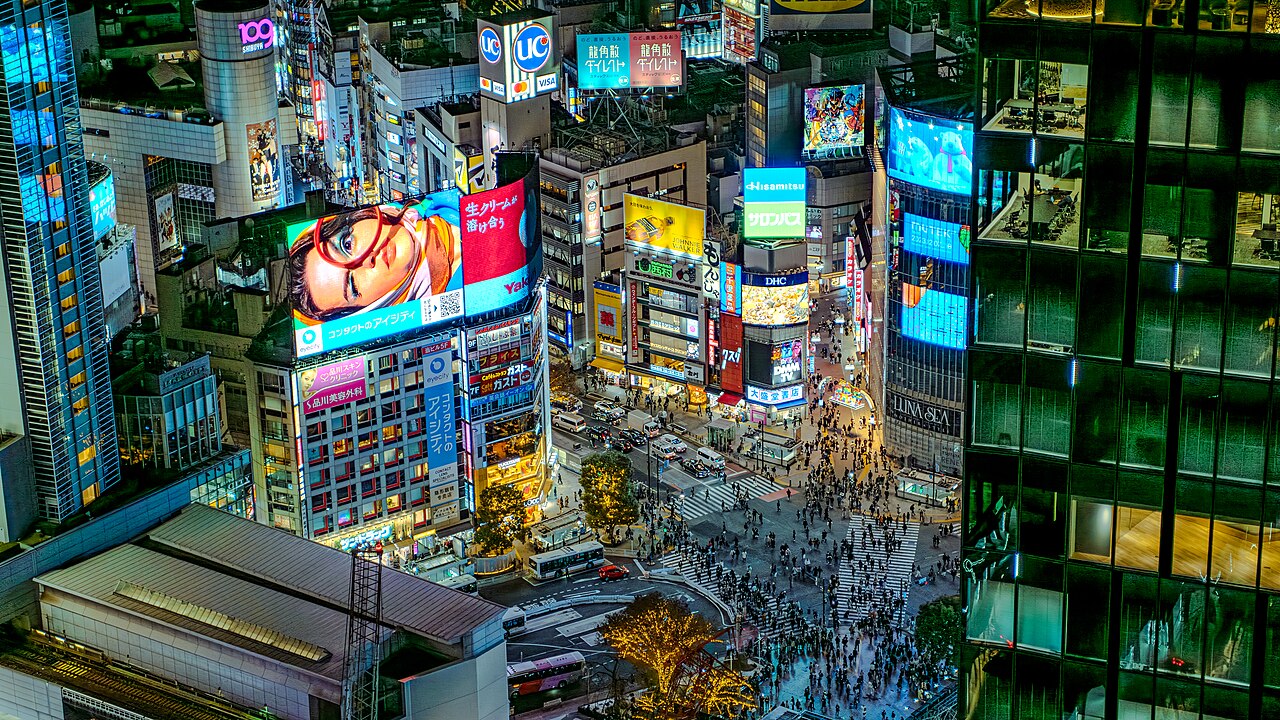
World's busiest pedestrian intersection — up to 3,000 people cross per light change. Go at night for the neon. Watch from Starbucks 2F (Tsutaya building) or Mag's Park rooftop.

"Body-immersive" digital art museum in Toyosu — walk barefoot through waist-deep water, mirror rooms, orchid gardens. 90 min. Book weeks ahead; the 90-min slots sell out.
Adult timed entry.

58-hectare former imperial garden just south of Shinjuku Station. Three gardens in one: French formal, English landscape, Japanese traditional. 1,000 cherry trees — prime sakura spot.
Worth it once the must-sees are done. Tap a row for the detail.

14th-century Buddhist temple with Tokyo Tower rising directly behind it — one of Tokyo's most photographed juxtapositions. Rows of Jizo statues with red bibs honour departed children.

243 m twin-tower government building in Shinjuku with FREE 202 m observation deck. On clear winter days, Mount Fuji is visible. The best view-for-free in Tokyo.

Electronics + anime/manga mecca. Eight-story anime stores (Mandarake, Animate), retro game shops (Super Potato), maid cafés, arcades (Taito Station, 6 floors). A few hours wander if you're not into the scene; all day if you are.

Two neon-lit alley networks in West Shinjuku. Golden Gai — 280 tiny bars (4–8 seats each), each with its own theme. Omoide Yokocho — "Memory Lane", 60 yakitori + ramen stands in WWII-era alleys.
Most Golden Gai bars have ¥500–1,500 seating charge.

Tokyo street-fashion capital. Takeshita Street is the teen pedestrian shopping strip (crepes, kawaii, kitsch); Omotesando next door is upscale (Prada, Issey Miyake architecture). Meiji Shrine is at one end.

Studio Ghibli museum in Mitaka (30 min from Shinjuku) — Spirited Away, My Neighbor Totoro, Castle in the Sky. Tickets only sold online, by month, on the 10th of the preceding month at 10:00 JST. Sells out in minutes.
Adult timed entry; specific day/hour.
The inner fish wholesale market moved to Toyosu in 2018, but the outer market (food stalls, sushi spots, knife shops) still operates exactly as before. Great morning breakfast + shopping run.

Massive cultural park in northeast Tokyo — Tokyo National Museum, Ueno Zoo (with giant pandas), cherry blossoms, and Shinobazu Pond with lotuses. Easy half-day.
Park free. Zoo ¥600. Museum ¥1,000.
Not worth your time or money.
Aug if you dislike crowds
Peak season: highest prices and longest queues
Paying ¥1,200 for Can of beer at 7-Eleven
Same beer at a tourist-area bar. Locals pay about ¥250.
Kabukicho touts offering "free drinks" (scam bars with ¥30,000+ bills)
Buying Ghibli Museum tickets from resellers (often fake)
Tipping anyone, anywhere
Photographing private homes in old neighbourhoods like Yanaka
Showing tattoos at traditional onsen without checking first
Off the beaten path — places most visitors never find.
Old Tokyo shopping street in northeast Taito — streets that escaped WWII bombing, tiny family shops, cats, cemetery next door. Zero neon.
Private collection of East Asian art + an astonishing landscape garden with teahouse in Minami-Aoyama. ¥1,500. Quiet refuge off Omotesando.
Restaurant supply district — plastic food models (the ones in restaurant windows), Japanese knives, ceramics. Great souvenir shopping.
Vintage shops, indie cafés, small music venues in a walkable grid west of Shinjuku. Japan's Williamsburg/Camden.
Indoor alley market of 20 small izakayas in Ebisu — rowdy, local, unfussy. Cheaper than Shibuya, tastier than Roppongi.
Plan your days
Copy a plan or let Tripdox build one around your dates.
Senso-ji Temple before crowds
Arrive by 08:00 for empty Thunder Gate shots.
Walk or train to Tokyo Skytree
20 min walk across the bridge.
Train to Tsukiji Outer Market lunch
Tamago skewer + sushi stand.
Imperial Palace East Gardens
Free walk around the moat.
Ginza shopping + Matcha soft-serve
Shibuya Crossing at dusk
Watch from Shibuya Sky (book online).
Dinner + drinks in Shinjuku
Omoide Yokocho yakitori alley + Golden Gai.
Last train or taxi back
Asakusa + Skytree + Ginza + Shibuya
Senso-ji before 09:00 crowds
Tokyo Skytree observation
Lunch at Tsukiji Outer Market
Imperial Palace East Gardens + Marunouchi
Ginza boutique walk
Shibuya Crossing + Shibuya Sky sunset
Shinjuku Omoide Yokocho dinner
Meiji + Harajuku + Shibuya + Roppongi
Meiji Shrine + Yoyogi Park
Harajuku Takeshita Street
Omotesando lunch
teamLab Planets (Toyosu, 90 min timed)
Roppongi dinner + Tokyo Tower view
Drinks in Roppongi or Shibuya
A theme for each day — reorder it around your flights.
Arrive, Shinjuku skyscrapers + Omoide Yokocho dinner
Senso-ji + Skytree + Tsukiji + Imperial Palace
Harajuku + Meiji + Shibuya + Shibuya Sky
Day trip to Hakone (onsen + Mt Fuji views)
Akihabara + Ueno + Yanaka old-town walk
teamLab Planets + Odaiba + Ginza
Ghibli Museum OR Kamakura day trip
A perfect day
10 stops from 06:30 to 00:30. Follow it end to end, or borrow the parts you like.
Meiji Shrine forest or Imperial Palace moat at dawn. Tokyo is at its quietest.
Onigiri + tamago sando + hot coffee from 7-Eleven, Lawson, or FamilyMart. ¥500. Genuinely good.
Senso-ji, Tokyo Skytree, or Tokyo National Museum. Japanese attractions open 09:00 or 09:30 and fill fast.
Ichiran, Afuri, or any small shop with a queue. ¥1,200 gets you a world-class bowl. Order via vending machine, slurp loudly.
Pick Harajuku, Shibuya, Akihabara, or Ginza depending on mood.
Matcha soft-serve ¥500 or a proper tea ceremony at Nakamura Tokichi (Ginza).
Shibuya Sky, Skytree, or Tokyo Metropolitan Government Building (free!).
Yakitori + highball at Omoide Yokocho, or counter sushi if you're splashing. ¥3,000–6,000 including drinks.
Golden Gai tiny bars, Big Echo karaoke, or a Taito Station arcade until the last train home.
Tokyo train lines stop around 00:30 – 01:00. Taxi home is ¥2,500–6,000 depending on distance.
Estimated spend for the day¥8,800
Based on the 5 of 10 stops that list a cost.
Food & drink
10 dishes to try and 8 places to eat in Tokyo, from about ¥1,100 to ¥6,000 a head.

Omakase at a counter (chef's choice) is the Tokyo experience. Affordable: ¥3,000–5,000 lunch. Mid: ¥8,000–15,000 dinner. Sukiyabashi Jiro level: ¥40,000+.
Counter lunch omakase range.

¥900–1,500 for a premium bowl. Tonkotsu (pork bone, Kyushu style), shoyu (soy), miso, tsukemen (dipping) — all ubiquitous.

Grilled chicken skewers — everything: thigh, breast, skin, tail, liver, heart, cartilage. ¥150–400 per stick. Omoide Yokocho has the classic alley experience.
Per skewer.

Flash-fried seafood + vegetables. A set is ¥1,500 at casual, ¥8,000+ at a specialist omakase counter.

Deep-fried breaded pork cutlet with rice, cabbage, miso soup. Maisen in Aoyama is the legend; ¥2,000–3,000.
.jpg/500px-%E5%B0%8F%E5%B7%9D%E8%8F%8A%E9%B0%BB%E9%AD%9A%E9%A3%AF_(49287165332).jpg)
Grilled eel over rice (unadon) with sweet soy glaze. Specialist restaurants only; ¥3,000–7,000.

Savoury pancake — cabbage, flour batter, your choice of toppings, cooked on a grill at the table. Osaka-style is more common. ¥1,200–2,000.
A5 Japanese beef — melts on contact. Yakiniku BBQ places charge ¥2,000–5,000 per 100 g slice.
Per 100g at a yakiniku.
Matcha soft serve, matcha parfait, matcha kitkats. ¥500–1,200.
Onigiri (¥200), karaage (¥300), oden, egg sandwiches, pudding. 7-Eleven, FamilyMart, Lawson — genuinely good, widely eaten.
Full meal under ¥800.
Our shortlist, cheap to splurge.
Afuri
Yuzu-shio ramen · Ebisu, Roppongi, Shinjuku
Signature: Yuzu-shio ramen (citrus-salt broth) — cleaner than tonkotsu
Ichiran Ramen
Tonkotsu ramen · Multiple (Shibuya, Shinjuku, Ueno)
Signature: Tonkotsu bowl — order via vending machine, eat in solo booth
Standing Sushi Bar Uogashi Nihonichi
Casual sushi · Shibuya, Ginza
Signature: Standing counter, fresh nigiri at ¥80–300 each
Kagari
Chicken paitan ramen · Ginza Coridor St
Signature: Creamy chicken broth ramen; expect 45-min queue.
Maisen (Aoyama)
Tonkatsu · 4-8-5 Jingumae, Shibuya
Signature: Rosu tonkatsu with mustard
Tsuta
Michelin-starred ramen · Yoyogi-Uehara
Signature: Truffle shoyu ramen — book an early slot online
Gonpachi (Nishi-Azabu)
Traditional izakaya · 1-13-11 Nishi-Azabu, Minato
Signature: Yakitori + robatayaki grills
The "Kill Bill" restaurant — book ahead.
Sushi Dai (Toyosu)
Sushi counter · Toyosu Market
Signature: Omakase lunch (10 pieces + negitoro roll + miso)
Line forms 04:30; plan to queue 2–3 hours for the lunch service.
Getting around
Tokyo has the world's best public transport — JR (Yamanote loop + regional), Tokyo Metro (9 lines), Toei Subway (4 lines), plus private lines (Keio, Odakyu, Tokyu). Use an IC card (Suica, Pasmo, or the new Welcome Suica / Pasmo Passport for tourists) — tap on and off at any gate. Walking distance between stations averages 500-800 m everywhere inside the Yamanote Line.
Everything — metro, JR, bus, vending machines, konbini
Minimum top-up; typical fare ¥150–300 per ride.
The circle loop through Shibuya, Shinjuku, Ueno, Akihabara, Tokyo Station
Min fare; typical loop ride ¥140–210.
Fills in everywhere the JR doesn't reach
Metro ¥170–320 per ride depending on distance.
After last train or with heavy luggage
Flag-fall; ¥100 per 237 m after.
Shinkansen to Kyoto, Hakone, Nikko
7-day all-Japan pass. Kyoto day trip alone is ¥28,000 round-trip.
5 options · multiple airports
Narita Express (N'EX) to Tokyo / Shinjuku
Reserved seat, every 30 min. IC card not accepted.
55 min
¥3,070
Keisei Skyliner to Ueno
Fastest from Narita. Every 20 min.
41 min
¥2,570
Access Express (cheap) to Asakusa
Local service, budget option.
75 min
¥1,270
Airport Limousine Bus (Narita)
Direct to major Tokyo hotels; best with luggage.
90 min
¥3,600
Keikyu Line / Tokyo Monorail from Haneda
Haneda is 20 min closer than Narita; always prefer if you have the choice.
25 min
¥500
Realistic travel times between the places you'll actually go.
Narita AirportShinjuku
Haneda AirportShibuya
Tokyo StationKyoto
ShinjukuHakone
ShinjukuNikko
Practical
Etiquette, money, a few words of Japanese, safety and what to pack.
Do
Avoid
Essentials
Climate
Cultural
Electronics
If something goes wrong
Save these before you land. Tap a number to call from your phone.
9-1 Akashi-cho, Chuo
6-7-1 Nishi-shinjuku, Shinjuku
3-19-18 Nishi-shimbashi, Minato
FAQ
Straight answers to the 19 questions first-time visitors ask most.
Two peak windows: late March to early May (mild, sakura, gardens) and October to November (dry, autumn leaves, crisp). Cherry blossom peaks approximately March 25 – April 5 — the most crowded and expensive dates. Autumn leaves (koyo) peak in late November to early December. Avoid Golden Week (Apr 29–May 5) and Obon (mid-August) — Japanese domestic travel surges prices 2–3x. Winter (Dec–Feb) is cold but crisp, sunny, cheap, and has the clearest Mt. Fuji views.
Five days is the minimum: two for central Tokyo (Shinjuku, Shibuya, Ginza, Imperial Palace), one for old Tokyo (Asakusa, Senso-ji, Skytree), one for a neighbourhood day (Harajuku, Meiji, Shimokitazawa, Akihabara depending on mood), and one for a day trip (Hakone, Kamakura, or Nikko). Seven days lets you add teamLab Planets, Ghibli Museum, and Kyoto via Shinkansen. Two weeks in Japan ideally splits as 7 Tokyo + 4 Kyoto + 3 Osaka/Hiroshima/elsewhere.
It's less expensive than you'd expect. Mid-range travelers spend ¥22,000–30,000 per day (~USD 150–200) including a business hotel in Shinjuku, three meals (including one nice izakaya), transport, and one paid attraction. Budget travelers can stay under ¥12,000 (~USD 80) with hostels and konbini food. Tokyo is cheaper than London, Paris, New York, or Sydney for daily costs. What's expensive: A5 wagyu, high-end sushi omakase, taxis after midnight, and airport shuttles.
No — but it helps more than in Europe. Major attractions, JR stations, tourist-oriented restaurants and hotels have English signage and English-speaking staff. Smaller local restaurants, izakayas, convenience store clerks, and taxi drivers often speak little English. Google Translate's camera mode reads Japanese menus and signs reliably. Learning "sumimasen" (excuse me / sorry), "arigatō gozaimasu" (thank you), and "eigo hanasemasu ka" (do you speak English) will get you through 95% of interactions.
Always prefer Haneda (HND) if you have the choice. Haneda is just 15 km south of central Tokyo (30 min by Keikyu Line or Monorail, ¥500-660); Narita (NRT) is 68 km east (55–90 min transit, ¥1,270–3,600). Haneda has better 24-hour flight options and is much closer to Shibuya/Ginza hotels. Narita is the legacy main airport for many US/Europe long-hauls. Both are fully accessible by public transit; just factor the extra 30-45 minutes for Narita.
Usually no, for a Tokyo-only trip. After the October 2023 price hike (¥50,000 for 7 days), the pass only pays off if you do 2+ Shinkansen round trips (e.g., Tokyo↔Kyoto is ¥28,000 round-trip; one trip alone doesn't cover the pass). For Tokyo-only: buy an IC card (Welcome Suica or Pasmo Passport) at the airport and top up — single fares are ¥150–300 per ride, far cheaper than the JR Pass. For 2-city trips (Tokyo + Kyoto + Osaka + Hiroshima), the pass makes sense.
Tokyo is one of the world's safest major cities for solo women. Violent crime is extremely rare. The two caveats: (1) train groping (chikan) on crowded commuter lines exists — use women-only carriages 07:00–09:30 on major JR lines if needed, (2) Kabukicho red-light district in Shinjuku has scam bars targeting tourists (never follow touts offering "free drinks"). Solo dining is culturally normal — ramen counters, sushi bars, and Ichiran's solo booths are designed for single diners.
Mostly cards, some cash needed. Major hotels, department stores, chain restaurants, and tourist attractions accept Visa/Mastercard. Traditional izakayas, ramen shops, mom-and-pop cafés, street stalls, and some temples are cash only. Carry ¥10,000–15,000 daily as backup. ATMs at 7-Eleven, FamilyMart, and Japan Post Bank reliably accept foreign cards; regular bank ATMs often don't. IC cards (Suica/Pasmo) can pay at many konbinis for small purchases.
Trains stop 00:30–01:00 — plan accordingly. If you're in Shinjuku or Shibuya past midnight, expect ¥2,500–6,000 taxi home. Night buses exist but cover limited routes. Some travelers simply stay out until the 05:00 first train (izakayas often close 23:00 but karaoke and some late-night bars run until 05:00). Tokyo has the world's highest density of capsule hotels if you genuinely get stranded — First Cabin and 9hours run ¥3,500–6,000 walk-in.
Yes — Tokyo tap water is among the world's safest and is served free at every restaurant. You can fill reusable bottles from any tap. Many public fountains and shrines also serve drinking water. Bottled water is widely available (¥100–150) but entirely unnecessary for safety.
If you only have 5–7 days in Japan: do Tokyo. If you have 10+ days: do Tokyo first (4–5 days), then Kyoto (3–4 days), then home from Osaka (KIX airport). Kyoto is older, quieter, temple-centric, and can feel slow after Tokyo's energy. Doing them in the reverse order (Kyoto first) often leaves travelers feeling Tokyo is overwhelming. The Shinkansen between them takes 2 hours 15 minutes.
Omakase sushi at a counter (the experience is the point, not just the food); Japan-only dishes like unagi (freshwater eel over rice), okonomiyaki (savory pancake), yakitori (all the less-common chicken parts — tail, heart, cartilage), tonkatsu Ikura-don, fresh wasabi (grated from the root at the table), and A5 wagyu yakiniku. Skip the sushi-chain tuna and go for chef's choice; skip the "best ramen in Tokyo" TikTok spots and find a smaller shop with a local queue.
Yes — Tokyo is excellent for families. Hits: Tokyo Disneyland/DisneySea (1 h train from central), Ghibli Museum (Mitaka, advance booking), Ueno Zoo (pandas), teamLab Planets (digital art + barefoot water rooms, ages 3+), Odaiba (waterfront with giant Unicorn Gundam), Tokyo National Museum, Kidzania Tokyo. Trains are stroller-friendly (lifts at every station), baby-changing rooms are in every major department store, and restaurants are universally kid-tolerant.
Yes — the OUTER Tsukiji market (food stalls, sushi spots, knife shops) never moved. The INNER wholesale fish market relocated to Toyosu in 2018 and is less fun to visit as a tourist. Go to Tsukiji Outer Market 07:00–09:00 for tamago skewers, sushi breakfast, and knife shopping. For a bigger fish-market experience, Toyosu has a tuna auction viewing deck (pre-booked, 05:30 AM, free).
Avoid: Kabukicho touts offering "free drinks" (scam bars with ¥30,000+ bills); buying Ghibli Museum tickets from resellers (often fake); tipping anyone, anywhere; photographing private homes in old neighbourhoods like Yanaka; showing tattoos at traditional onsen without checking first; visiting during Golden Week or Obon if you can avoid it; airports with taxi queues when trains are right there; overpaying for the JR Pass if you're Tokyo-only.
70+ nationalities (US, UK, EU, Australia, Canada, New Zealand, South Korea, Singapore, Malaysia, Thailand) enter visa-free for 90 days. Indian, Chinese, and Russian passport holders need a tourist visa via the Japanese embassy/consulate (typically 5–7 business days). Japan introduced an electronic JESTA system (similar to US ESTA) being rolled out through 2026 — check the latest at mofa.go.jp before booking. All arrivals complete Visit Japan Web digital customs + immigration forms pre-arrival.
Both are excellent; they differ on what they're best at. Tokyo: food scene is world-leading (more Michelin stars than any city); cleaner, quieter, more organised; older + more traditional (shrines, temples, kabuki). Seoul: more affordable (hotels 40% cheaper, food 30% cheaper); better nightlife; younger, more energetic vibe; K-pop, K-drama, K-beauty shopping. If you have one trip: Tokyo for depth and culinary focus; Seoul for energy and value. Both deserve 5–7 days.
Winter in Tokyo is cold, dry, and sunny — not snowy like Hokkaido. Daily highs in December–February run 8–12°C, lows 1–4°C. Tokyo sees snow perhaps 2–3 days a winter, usually melting by afternoon. Pack a warm coat, scarf, thermal layer, but no snow boots. The trade-off: clearest weather of the year (best Mt. Fuji views in January), fewest tourists, hotel prices 30–40% below peak, illuminations lit across the city late Nov – late Feb.
Yes — the classic routes are via Hakone (onsen resort with Fuji views, 90 min by Odakyu Romancecar) or Lake Kawaguchiko (closer, clearer views, 2h by bus from Shinjuku). Clearest Fuji views are December–February (dry air, snow-capped peak). Climbing Fuji itself is only possible July–early September; the rest of the year the summit route is closed. For a one-day Fuji experience, Kawaguchiko gives the iconic reflection shot; Hakone pairs Fuji with onsen + open-air museums + pirate-ship lake cruises.
Your move
Describe your trip in a few sentences. Tripdox finds flights, picks hotels, orders your days and builds the full itinerary — priced in JPY or your own currency.
Free · No credit card · 2 minutes
More guides built the same way — read one, then let Tripdox plan it.

Golden temples, five-dollar street food, rooftop bars in the sky, and 11 million people negotiating a city that somehow never sleeps


.jpg/1280px-Day2-2_(40909714314).jpg)



_The_Dubai_Fountain_at_Dusk_02.jpg/1280px-(UAE)_The_Dubai_Fountain_at_Dusk_02.jpg)

