Spring
BestApr – Jun
Mild 18-24°C, blooming, ideal
Average low–high: 13–22°CMonthly rainfall: 50 mmCrowds: High
.jpg/1280px-Alfama_Rooftops_and_Tagus_River_View,_Lisbon_(54733828355).jpg)
Portugal
The complete 2026 travel guide
Seven hills + yellow trams + pastel tile facades + fado songs drifting out of Alfama alleys — Europe's oldest Atlantic capital, and still the cheapest Western European one.
Free · No credit card · 2 minutes
The short answer
Yes — worth it for Hills + Trams, Fado, Pastéis de Nata. Plan 3–4 days, ideally in Apr–Jun · Sep–Oct. Seven hills + yellow trams + pastel tile facades + fado songs drifting out of Alfama alleys — Europe's oldest Atlantic capital, and still the cheapest Western European one.
Go if you want
Think twice if
Lisbon is Western Europe's westernmost capital — 550,000 people packed into a hilly Atlantic coast city. The historic center (Baixa + Chiado + Alfama) sits below seven hills, connected by iconic yellow trams, funiculars, and the Santa Justa elevator. First-time visitors do 3-4 days; 5-6 unlocks Sintra (40 min by train — Pena Palace + Quinta da Regaleira) + Cascais beach day trip + Porto (2h 45m AVE).
Lisbon's 4 main zones. Baixa + Chiado in the lower center — Rossio Square, Commerce Square, grand streets. Alfama is the Moorish-era oldest quarter with narrow cobbled lanes + fado houses. Bairro Alto is the nightlife + bohemian quarter on a hill. Belém west has the monuments (Jerónimos Monastery, Belém Tower, Padrão dos Descobrimentos) + the original Pastéis de Belém bakery. LX Factory + Time Out Market for modern dining.
Lisbon is Western Europe's affordability sweet spot — mid-range daily €120-180/person including 3-star hotel + meals + metro + museums. Budget travelers can easily do €70-90/day. Tram 28 (the famous yellow rattling route through Alfama) is €3 per ride or included in a 24h Lisboa Card. Portuguese is the official language but English is widely spoken in tourism.
Before you go
The details that change a trip — read these before you book.
Pastéis de Belém (since 1837) is the original custard tart spot — sold 30,000+ a day, line moves fast. Manteigaria (Chiado) is the modern rival — many prefer it.
Belém Tower closed for renovation through Spring 2026 — check torrebelem.pt before visiting; exterior photos still possible.
Tram 28 at 08:00 Monday or after 21:00 Saturday is much less crowded than peak tourist hours.
Sintra combo ticket (Pena Palace + Moorish Castle + Quinta da Regaleira) saves 15-20% + allows you to pick timings. Book online 2-3 days ahead.
Sunset from Miradouro da Senhora do Monte (free, 360° view) or Miradouro de São Pedro de Alcântara is better than any paid viewpoint.
A Ginjinha shot (€1.50) at the 1840 original bar in Rossio — stand, shoot, appreciate, move on.
Lisboa Card (€22 24h) includes free public transit + 30 free attractions + discounts — pays off if visiting 3+ paid sights.
Avoid restaurants advertising "tourist menu" in 5 languages — walk side streets for real tascas.
When to go
April-June and September-October are peak — mild 18-25°C, less tourist crush than July-August. Winter (Nov-Mar) is mild (13-18°C) + wet. Summer hot + dry + crowded.
Spring
BestMild 18-24°C, blooming, ideal
Summer
Warm 28-32°C, dry, peak crowds
Autumn
BestIdeal — warm days + cool nights, Atlantic still swimmable
Winter
Mild + rainy 13-17°C, rare cold snaps, quieter
Bar color follows the average high (cool blue → hot coral); faded bars fall outside the best months. The shaded base is the average low.
Swipe for Jul–Dec →
How long
3–4 days is the sweet spot. Three days covers essentials: Castelo + Alfama + fado + tram 28; Belém monuments + LX Factory; Sintra day trip. Five days adds Cascais beach + Bairro Alto nightlife + deeper food + a Porto day trip.
Arrive, Chiado + Rossio + ginjinha
From the week plan
EssentialCastelo + Alfama + fado dinner
From the week plan
EssentialBelém monuments + LX Factory
From the week plan
EssentialDay trip — Sintra full day
From the week plan
Worth itCascais + Estoril coast beach day
From the week plan
If you have timeBairro Alto + Príncipe Real + Time Out Market
From the week plan
If you have timePorto day trip (2h 45m AVE) OR departure
From the week plan
If you have timeBudget
Moderately — Lisbon sits mid-table among the cities we cover. Mid-range travelers spend about €170/day per person — pricier than 9 of the other 21 cities we cover. That's roughly €510–€680 for 3–4 days. Backpackers get by on €80/day; luxury starts around €500/day.
Backpacker
€80
per person · per day
Hostel + pastel de nata + tasca + free attractions + Viva Viagem.
Mid-range
Most common€170
per person · per day
3-star hotel Chiado + tascas + 2 paid attractions + Lisboa Card.
Luxury
€500
per person · per day
Four Seasons Ritz / Tivoli Avenida Liberdade / EPIC SANA + Belcanto tasting + Sintra private tour.
Your trip, roughly
≈ €510–€680 for 3–4 days
mid-range · per person · before flights
Biggest markups first — what locals pay vs. the first price tourists get quoted.
Pastel de nata
3.3× markupManteigaria or Pastéis de Belém. · Tourist price: Airport or tourist-trap bakery.
Ginjinha shot
3.3× markupTasca menu del día
2.5× markupTourist price: Baixa tourist restaurant.
Cod bacalhau dish
2.3× markupTourist price: Waterfront tourist spot.
Taxi airport to center
2.2× markupWith supplement. · Tourist price: Unlicensed driver.
Fado dinner + show
2× markupAlfama authentic spot. · Tourist price: Hotel concierge bundle.
Metro + tram single
1.6× markupTourist price: Buying on tram 28 cash.
Book first
2 things in Lisbon sell out or need a timed slot. Work backwards from your dates: Hotels first (3 months out). The timeline below runs from 3 months out down to before you fly: 1 sight to book and your hotel.
Book 2-3 months ahead for Apr-Jun + Sep-Oct
Pena Palace sells out daily — book exact time online 1-2 days ahead.
Neighborhoods
Chiado / Baixa for a first visit — central, historic, walking distance. 6 areas compared below, from €110 to €230 a night. Belém is the best value at about €110 a night. Book hotels 3 months out for the busiest dates.
.jpg/1280px-Lisbon_10064_Lisboa_Pra%C3%A7a_Lu%C3%ADs_de_Cam%C3%B5es_2006_Luca_Galuzzi_(cropped).jpg)
Central, historic, walking distance
from €140 / night
Medieval cobbled + fado houses + castle
from €120 / night
Hip + boutique + nightlife
from €150 / night
Grand boulevard + luxury shopping + wide streets
from €230 / night
.jpg/1280px-Santa_Maria_de_Bel%C3%A9m_sul_Tago_-_panoramio_(cropped).jpg)
Museum quarter + monuments + quieter
from €110 / night
Industrial-hip + 25 de Abril Bridge views
from €130 / night
Things to do
6 must-sees, 8 more if you have time, and 7 things to skip. Start with Jerónimos Monastery (Mosteiro dos Jerónimos) and Alfama. Most must-sees sit within a 15-minute walk of another stop — the 3 walkable groups below pair them into half-days. First thing to skip: Jul–Aug if you dislike crowds.
Relative positions, not to scale. Numbered points are the must-sees.
Also on the map: Torre de Belém (Belém Tower), Padrão dos Descobrimentos (Monument to the Discoveries), Bairro Alto, Praça do Comércio, Rossio Square (Praça de D. Pedro IV), Santa Justa Lift (Elevador de Santa Justa), Cristo Rei
Farther out: Sintra (day trip) · Cascais (coastal day trip)
Places within a 15-minute walk of each other, grouped into half-days.
Alfama, Tram 28 (Elétrico 28), Castelo de São Jorge, Praça do Comércio, Rossio Square (Praça de D. Pedro IV), Santa Justa Lift (Elevador de Santa Justa)
Jerónimos Monastery (Mosteiro dos Jerónimos), Padrão dos Descobrimentos (Monument to the Discoveries)
The must-sees.
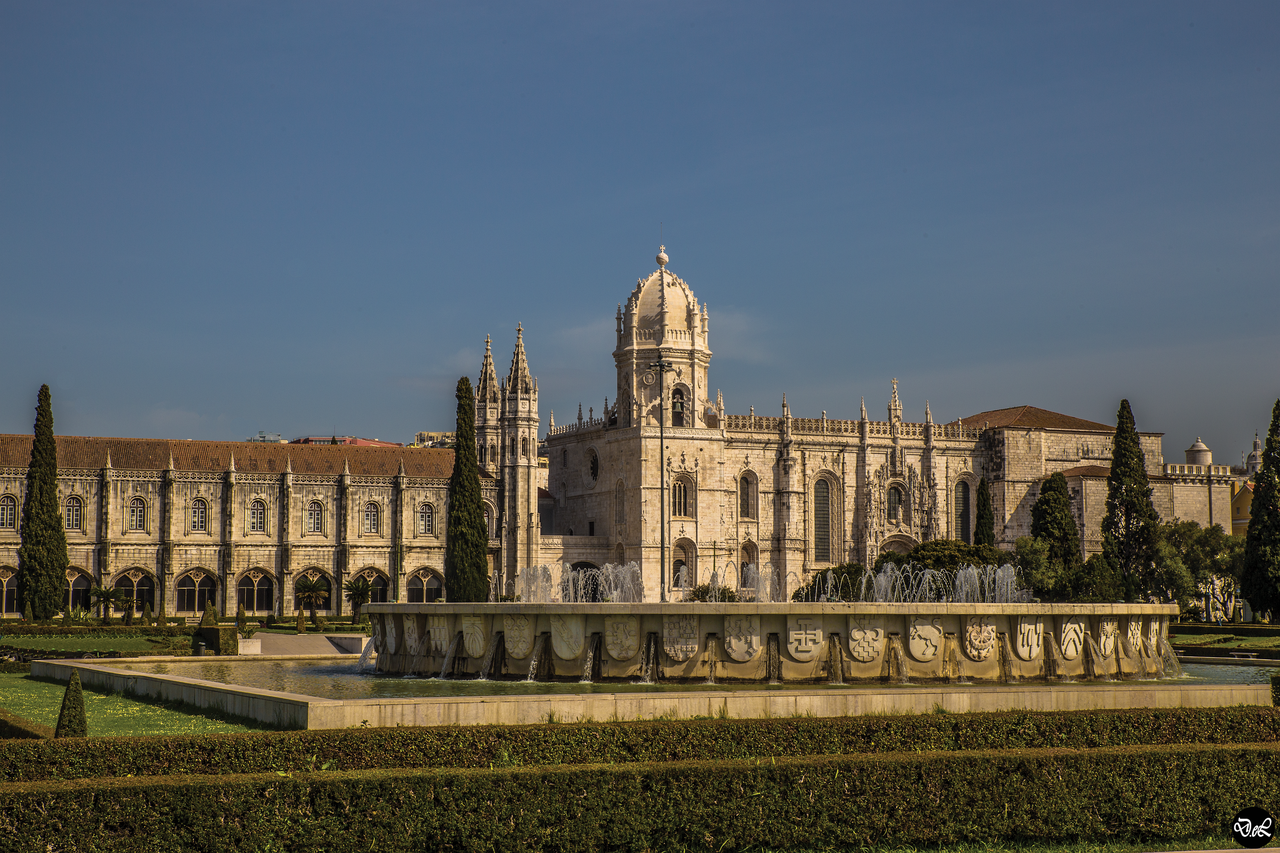
1501 Manueline-style monastery — UNESCO. Vasco da Gama's tomb, Fernando Pessoa's tomb, soaring cloisters, Age of Discovery celebration.
Adult; free on 1st Sunday of month; €16 combo with Belém Tower.

Moorish-era oldest Lisbon neighborhood — survived the 1755 earthquake. Narrow cobbled alleys, tiled facades, laundry strung between windows, fado houses. Lisbon's soul.
Iconic yellow rattling route from Martim Moniz → Alfama → Baixa → Chiado → Estrela. 45-min circuit through Lisbon's steepest cobbled streets. WARNING: Tourist-mobbed.
Single on tram; free with 24h Carris pass or Lisboa Card.

Medieval hilltop castle from Moorish era — panoramic 360° view over Lisbon + Tagus River. Walls walkable, towers climbable, peacocks roaming.
Adult; +€3 audio guide.
500-seat food hall in the old Mercado da Ribeira — 32 stalls curated by Time Out magazine. Michelin-starred chefs' tapas portions + affordable.
Food portions €6-20 per dish.
_(cropped2).jpg/1280px-Sintra_-_Palacio_da_Pena_(20332995770)_(cropped2).jpg)
UNESCO-listed mountain town 40 min by train — Pena Palace (colorful Romanticism castle), Moorish Castle ruins, Quinta da Regaleira (Initiation Well). Half-day minimum.
Pena Palace €14; Quinta da Regaleira €15; Moorish Castle €12; combined passes available.
Worth it once the must-sees are done. Tap a row for the detail.
1519 Manueline defensive tower on the Tagus — UNESCO. IMPORTANT: Closed for major renovations through Spring 2026 — check status before visiting.
Adult when open; free on 1st Sunday of month.
52 m 1960 monument celebrating Portugal's Age of Discovery — 33 Portuguese explorers including Vasco da Gama, Magellan, Prince Henry the Navigator.
Monument rooftop adult.

Nightlife + bohemian quarter on a hill — cobbled streets, graffiti, restaurants, bars. Peak alive 22:00-03:00 weekends.
_(cropped).jpg/330px-Lisbon_(36211708233)_(cropped).jpg)
Lisbon's grand 18th-century riverfront square — rebuilt after 1755 earthquake. Arco da Rua Augusta (climbable €3), statue of King José I, restaurant terraces facing Tagus.
Square free; arch climb €3.
.jpg/330px-Teatro_Nacional_D._Maria_II_from_Rossio_Square_(42119946034).jpg)
Main central square — fountains, wave-patterned cobblestone pavement ("Portuguese pavement"), National Theatre D. Maria II. Ginjinha shots nearby at A Ginjinha (since 1840).

1902 Gustave Eiffel-designed iron elevator connecting Baixa to Bairro Alto. Viewing platform at top. Tourist-heavy; locals use it as transit.
Adult round-trip including viewing platform; free with Carris 24h pass.
.jpg/330px-Cascais_-_Santa_Marta_(53854018150).jpg)
Former fishing village + royal summer retreat 40 min by train on the Atlantic coast — beaches, surfing, seafood. Boca do Inferno sea cave.
110 m tall Christ the King statue on the southern bank of Tagus — ferry + bus to base, elevator up. Panoramic view of Lisbon + 25 de Abril Bridge.
Adult elevator; base free.
Not worth your time or money.
Jul–Aug if you dislike crowds
Peak season: highest prices and longest queues
Paying €5 for Pastel de nata
Airport or tourist-trap bakery. Locals pay about €1.50.
Restaurants on Rua Augusta + tourist-area tram 28 vending (€6 rides vs real €3)
"drug dealers" whispering hashish (fake substances)
Unofficial taxis (use Bolt/Uber)
Bacalhau at tourist restaurants (boiled + bland vs tasca version)
Ridge ride scams
Off the beaten path — places most visitors never find.
Hilltop bohemian viewpoint with a bar serving drinks + sunset over the Tagus + 25 de Abril Bridge. Younger crowd, free.
1389 Carmelite church ruined in 1755 earthquake, now open-roof atmospheric archaeological museum. €5.
Dedicated museum of Portuguese tiles (azulejos) housed in a 1500s convent. €8. Sunday morning empty.
Hip industrial complex — design shops, specialty coffee, Sunday farmers market, street art, restaurants.
"Thieves' Market" — weekly flea market with antiques, books, curios. Sunday + Tuesday mornings.
Plan your days
Copy a plan or let Tripdox build one around your dates.
Breakfast + pastel de nata at Manteigaria
Castelo de São Jorge at opening
Walk through Alfama + Miradouro Santa Luzia
Lunch at O Zé da Mouraria (cash only)
Tram 28 to Estrela + back to Martim Moniz
Tram 15 to Belém
Jerónimos Monastery + Pastéis de Belém original tart
Padrão dos Descobrimentos + sunset on Tagus
Time Out Market dinner
Fado in Alfama (Clube de Fado or Tasca do Chico)
Castle + fado + Baixa
Castelo de São Jorge
Alfama walk + Miradouro + Santa Luzia
Lunch at a tasca
Tram 28 circuit
Commerce Square + Rua Augusta + Santa Justa Lift
Bairro Alto aperitivo
Fado dinner in Alfama
Monuments + hip quarters
Tram 15 to Belém
Jerónimos Monastery
Pastéis de Belém + Padrão dos Descobrimentos
LX Factory lunch + shopping
MAAT (Museum of Art, Architecture + Technology)
Sunset at Miradouro de Santa Catarina
Time Out Market or A Cevicheria dinner
A theme for each day — reorder it around your flights.
Arrive, Chiado + Rossio + ginjinha
Castelo + Alfama + fado dinner
Belém monuments + LX Factory
Day trip — Sintra full day
Cascais + Estoril coast beach day
Bairro Alto + Príncipe Real + Time Out Market
Porto day trip (2h 45m AVE) OR departure
A perfect day
9 stops from 08:30 to 01:00. Follow it end to end, or borrow the parts you like.
Pastel de nata + galão (milky coffee) + torrada at a corner café. €4-6.
Castelo de São Jorge, Jerónimos, or Sintra train.
Set lunch at a traditional tasca — soup + main + bread + wine €10-15. Carne de porco à alentejana is classic.
Miradouros (viewpoints): Portas do Sol, Santa Catarina, Senhora do Monte, Graça.
Fresh from oven at Manteigaria or Pastéis de Belém. €1.30-2.50 + espresso.
Bairro Alto wine bars or A Ginjinha cherry liqueur €1.50. Vinho Verde €3-4.
Time Out Market €25, tasca €25-35, or Belcanto tasting €225.
Fado house (Alfama or Mouraria) with dinner €70-100, or bar hop Bairro Alto €4-8 per drink.
Clubs open 01:00-04:00 Friday + Saturday. Lux Frágil + Musicbox are legends.
Estimated spend for the day€122
Based on the 6 of 9 stops that list a cost.
Food & drink
9 dishes to try and 8 places to eat in Lisbon, from about €8 to €225 a head.

Portuguese custard tart — crispy pastry + warm vanilla cream + cinnamon dust. Pasteis de Belém (since 1837) is the original; Manteigaria + Fábrica da Nata are strong alternatives. €1.30-2.50.

Salt-dried cod. "365 ways to cook bacalhau" — pastéis de bacalhau (codfish cakes) + bacalhau à brás (with eggs + potatoes).

Grilled fresh sardines with salt + lemon + boiled potatoes. Peak June festival season.
Per plate of 5-6.

Galician soup with shredded kale + potato + chorizo. Winter comfort.

Seafood rice stew — shellfish + white wine + tomato + coriander. Shareable.
Per 2 people.
.jpg/500px-Francesinha_Sandwich_(cropped).jpg)
Massive layered sandwich with steak + sausage + ham + melted cheese + beer-tomato sauce + fried egg. Porto specialty but everywhere.

Sour cherry liqueur (20% ABV) — traditional shot served in small cup. A Ginjinha (since 1840) is the original.
Shot.
Vinho Verde (slightly sparkling white) + Douro reds + Port wine + Madeira. Best-value wine country in Europe.
Glass at a tasca.

Pork sandwich — marinated pork + mustard + crusty bread. €3-5 at traditional tascas.
Our shortlist, cheap to splurge.
Pastéis de Belém
Custard tart since 1837 · Rua de Belém 84
Signature: Original pastéis de nata — secret recipe from 1837
O Zé da Mouraria
Old-school tasca · Rua João do Outeiro 24
Signature: Bacalhau à brás; cash only, lunch only, 35-seat traditional.
Taberna da Rua das Flores
Contemporary petiscos · Rua das Flores 103
Signature: Tapas-style Portuguese small plates; chalk board menu changes daily.
Time Out Market
Curated food hall · Cais do Sodré
Signature: 32 stalls of Lisbon's best chefs — sample 3-4 small portions
A Cevicheria
Modern ceviche + Peruvian-Portuguese · Rua Dom Pedro V 129, Príncipe Real
Signature: No reservations; arrive 19:30 + expect queue.
Cervejaria Ramiro
Seafood tavern · Av Almirante Reis 1
Signature: Gambas à la plancha + lobster; 90-min queue typical, arrive 18:30.
Clube de Fado
Fado dinner + show · Rua de São João da Praça 94
Signature: Authentic fado + traditional dinner in 12th-century crypt.
Belcanto
Modern Portuguese tasting · Largo de São Carlos 10
Signature: 2-Michelin-star; José Avillez tasting; book 2-3 months ahead.
Getting around
Lisbon has 4 metro lines + iconic yellow trams + funiculars + Santa Justa Lift + buses. Single €1.90, 24h unlimited €7.25 (metro + bus + tram + funiculars). Viva Viagem rechargeable card €0.50. Trams + metros cover most tourist routes; walking Chiado + Baixa is fast. Hills are brutal — use trams + funiculars + lift.
Everything in city
Single; 24h unlimited €7.25; 3-day €30 with Lisboa Card.
Reloadable transit card
Card itself €0.50; load zapping amount for per-ride fares.
Airport transfer
Single from airport Aeroporto station; +€0.50 Viva Viagem.
Late night + luggage
Typical 5 km €8-12. Airport €15-20.
Cacilhas + Cristo Rei + Almada
Cais do Sodré to Cacilhas — 10 min.
4 options · fastest 20 min · cheapest €1.65
Metro Red Line from LIS to city
FastestCheapestAeroporto station at Terminal 1; Viva Viagem required.
20 min
€1.65
Aerobus 91/96 to Cais do Sodré
Direct to central Lisbon.
35 min
€4
Uber / Bolt from LIS
Fastest20 min
€15
Taxi from LIS
Fastest+€1.60 airport surcharge; metered but predictable.
20 min
€18
Realistic travel times between the places you'll actually go.
Lisbon Airport (LIS)Rossio
RossioBelém
RossioAlfama castle
LisbonSintra
LisbonPorto
Practical
Etiquette, money, a few words of Portuguese, safety and what to pack.
Do
Avoid
Essentials
Climate
Cultural
Electronics
If something goes wrong
Save these before you land. Tap a number to call from your phone.
Av Professor Egas Moniz
Av 24 de Julho 171A
Rua Abílio Mendes 12
FAQ
Straight answers to the 18 questions first-time visitors ask most.
April-June and September-October are ideal — mild 18-25°C, less tourist crush than July-August. Avoid July-August if possible (peak crowds + 28-32°C). Winter (Nov-Mar) is mild + rainy + significantly cheaper. October still swimmable at Cascais beaches.
Three days covers essentials: Castelo + Alfama + fado + tram 28; Belém monuments + LX Factory; Sintra day trip. Five days adds Cascais beach + Bairro Alto nightlife + deeper food + a Porto day trip. Seven days ideal for Lisbon + day trips (Sintra, Cascais, Óbidos).
Western Europe's affordability sweet spot — mid-range daily €120-180 (~USD 135-200). Budget: €75-90/day. Luxury: €500+. Cheaper than Madrid by 10-15%, cheaper than Paris/London/Amsterdam by 30-40%. Portuguese wine + tascas are especially great value. Hotel costs have risen 30-40% since 2020 but still cheaper than peers.
Belém Tower is CURRENTLY CLOSED for major renovation through Spring 2026. Check torrebelem.pt for current reopening status. Exterior photos from the riverbank still possible. Adjacent Jerónimos Monastery is open + must-see — €10 adult.
Portugal is in Schengen Area. 60+ nationalities get 90 days in 180 days visa-free. From 2025, US/UK/Canada/Australia/Japan citizens need ETIAS (€7 online, 3-year validity). Indian + Chinese + African passports require Schengen visa. Passport valid 3+ months after departure.
Yes — generally very safe. Violent crime against tourists rare. Main issues: pickpocketing on tram 28 + Alfama streets + tourist sites. Keep phone in zipped front pocket; crossbody bag across body. "Drug dealers" whispering hashish sell fake substances — ignore. Solo walks at night in Bairro Alto + Alfama are safe.
Pastéis de nata (at Pasteis de Belém or Manteigaria); bacalhau à brás (salt cod with potatoes + eggs); sardinhas assadas (grilled sardines June festival season); arroz de marisco (seafood rice); bifana (pork sandwich); ginjinha cherry liqueur shot; Portuguese wines (Vinho Verde + Douro reds). Michelin: Belcanto (2-star). Food hall: Time Out Market. Tasca: O Zé da Mouraria.
Excellent — safe, affordable, English widely spoken in tourism, friendly tasca culture where eating alone is fine. Pub crawls + free walking tours daily. Lisbon has active hostels in Chiado + Alfama. Solo female travelers report Lisbon as easy + safe.
CP train from Rossio or Oriente station direct to Sintra — 40 min, €4.55 round-trip. Trains every 20 min, first 06:00, last 23:00. At Sintra: 434 bus circuits the 3 main sights (Pena Palace + Moorish Castle + Quinta da Regaleira) — €7.80 day pass. Book Pena Palace ticket online 2-3 days ahead (€14 entry). Full day trip 08:00-20:00.
Yes — Lisbon tap water meets EU standards + is safe. Most locals drink bottled water due to taste (slightly hard). Restaurants serve tap water on request ("água da torneira"). Bottled water €1-2.50.
Fado = Portuguese melancholic traditional music, UNESCO intangible heritage. Live in fado houses in Alfama + Mouraria. Recommended: Clube de Fado (€75 dinner + show), Parreirinha de Alfama (€50 show + drinks), Tasca do Chico (free if you buy drinks, Bairro Alto). Shows run 21:00-midnight. Respect silence during songs; applause after.
Both excellent for different reasons. Lisbon: bigger, more diverse, more nightlife, coastal + Atlantic surfing. Porto: smaller, cheaper (10-15% below Lisbon), port wine capital, Douro river + vineyard day trips. First-time Portugal: Lisbon for breadth; Porto for concentrated charm. Ideal: 4-5 days Lisbon + 3 days Porto, connected by 2h 45m AVE train €30-65.
Lisboa Card (€22 24h, €36 48h, €44 72h) includes unlimited transit + 30+ free attractions (Jerónimos, Tile Museum, Santa Justa Lift, tram 28, Sintra train) + discounts. Worth it if visiting 3+ paid attractions + using public transit. Don't buy for shorter 2-day trips where walking + single metro tickets suffice.
Avoid: restaurants on Rua Augusta + tourist-area tram 28 vending (€6 rides vs real €3); "drug dealers" whispering hashish (fake substances); unofficial taxis (use Bolt/Uber); bacalhau at tourist restaurants (boiled + bland vs tasca version); ridge ride scams; overpriced pastéis at airport (€4 vs €1.50 in town).
Yes very hilly — seven hills, many steep cobbled streets. Good walking shoes + grip are essential. Elderly or mobility-limited travelers should use trams + funiculars + Santa Justa Lift. Cobblestones slippery when wet — stormy days make walking hazardous.
Alfama: oldest Moorish-era neighborhood, cobbled narrow alleys, residential + fado houses, quieter evenings. Bairro Alto: 18th-century grid + hilltop + bar/nightlife district, crowded 20:00-03:00 weekends. First time: explore both. Stay: Alfama for atmosphere, Bairro Alto for bar hop access.
Yes — Oceanário de Lisboa (one of world's best aquariums, €22), Jardim Zoológico, Parque das Nações (modern district with cable car), Pavilhão do Conhecimento (science museum). Cobblestone streets + hills make stroller use difficult; ergonomic carriers better. Most restaurants welcome kids.
Atlantic coast: 15°C (winter) to 20°C (summer) — colder than Mediterranean. Swimmable Jun-Sep; wetsuits common rest of year. Cascais beaches are family-oriented; Praia do Guincho (10 km west) is surfing-famous with bigger waves.
Your move
Describe your trip in a few sentences. Tripdox finds flights, picks hotels, orders your days and builds the full itinerary — priced in EUR or your own currency.
Free · No credit card · 2 minutes
More guides built the same way — read one, then let Tripdox plan it.

Volcanic peaks, rice-terrace villages, surf coastlines, and centuries-old Hindu temples

_(cropped).jpg/1280px-Avenida_da_Liberdade_(22344060581)_(cropped).jpg)
_(cropped).jpeg/1280px-25_De_Abril_Bridge_(226290561)_(cropped).jpeg)

.jpg/330px-Lisbon-Day3-1_(34184431096).jpg)


_(26003375942).jpg/330px-Drinks_at_Mercado_da_Ribeira_(Lissabon_2016)_(26003375942).jpg)
.jpg/1280px-Lisbon-Day3-1_(34184431096).jpg)
_(26003375942).jpg/1280px-Drinks_at_Mercado_da_Ribeira_(Lissabon_2016)_(26003375942).jpg)

.jpg/1280px-Mandrem_Beach_and_Mandrem_River,_Mandrem,_Goa,_India_(edit).jpg)

