Dry peak
BestJun – Aug
Sunny, dry, breezy
Average low–high: 23–30°CMonthly rainfall: 50 mmCrowds: Very high

Indonesia
The complete 2026 travel guide
Volcanic peaks, rice-terrace villages, surf coastlines, and centuries-old Hindu temples — Indonesia's spiritual island in one trip.
Free · No credit card · 2 minutes
The short answer
Yes — worth it for Beach, Surf, Temples. Plan 7–14 days, ideally in May–Sep. Volcanic peaks, rice-terrace villages, surf coastlines, and centuries-old Hindu temples — Indonesia's spiritual island in one trip.
Go if you want
Bali isn't one destination — it's at least four. Inland Ubud is the cultural heart: rice paddies, yoga retreats, monkey-filled temples, and slow mornings at riverside cafés. The south coast (Seminyak, Canggu, Kuta, Uluwatu) is where surf breaks, beach clubs, and digital-nomad cafés cluster. The east (Sanur, Amed, Sidemen) is calmer, cheaper, and the gateway to the Gili Islands and Nusa Penida. The north and west (Munduk, Pemuteran, Lovina) are quietest of all — waterfalls, dolphins, and almost no traffic.
A first Bali trip almost always splits between two bases: 3-4 nights in Ubud for culture and waterfalls, then 4-5 nights on the south coast for beach and nightlife. Add a day trip to Nusa Penida for the famous T-Rex viewpoint at Kelingking Beach, a sunrise hike up Mount Batur, and at least one Kecak fire dance at Uluwatu Temple — that's the standard week.
Distances on the map look short but the roads don't scale linearly. Ubud to Uluwatu is 65 km but takes 2-2.5 hours on a Saturday afternoon; airport to Ubud is 75 minutes off-peak, 2+ hours in rush hour. Most travelers hire a private driver for full days (~750k IDR) or rent a scooter (~75k IDR/day) for short hops within a base.
Before you go
The details that change a trip — read these before you book.
Book a private driver for full days only when you're combining 3+ stops — for short hops, Grab Bike is 5x cheaper
Skip Kuta entirely unless you're a 19-year-old on a first-time backpacker trip — it's declining and Canggu is better in every way
Sidemen Valley is what Ubud was 15 years ago — book 2 nights here if you're a repeat Bali visitor
Mount Batur sunrise hike is Bali's most-overrated experience — it's shoulder-to-shoulder with 300 other tourists at the top. Try Mt Agung's harder hike or skip
For Nusa Penida, do a private boat charter (4M IDR for the day, splits 6 ways) instead of the group tour — same sights, no waiting
Best Balinese coffee isn't kopi luwak (overpriced civet coffee) — it's plain Bali Kintamani arabica from any small roaster
Spa packages at boutique villas are 30-50% cheaper than the same treatments at hotel spas — book direct via Instagram or WhatsApp
For Gili Islands, take fast boats from Padang Bai (cheaper, less choppy) instead of Serangan
When to go
May to September — dry season, lower humidity, calm seas, every restaurant and beach club open.
Dry peak
BestSunny, dry, breezy
Dry shoulder
BestWarm, dry, manageable crowds
Wet shoulder
Humid, occasional storms, lush
Wet peak
Daily afternoon rain, very humid
Bar color follows the average high (cool blue → hot coral); faded bars fall outside the best months. The shaded base is the average low. Teal bars below show monthly rainfall.
Swipe for Jul–Dec →
How long
7–14 days is the sweet spot. Seven days minimum for a first trip. The standard split is 3-4 nights in Ubud (culture, rice terraces, monkey forest, Mount Batur sunrise hike) + 4-5 nights in Seminyak/Canggu/Uluwatu (beach clubs, surf, sunset temples).
Arrival — drive to Ubud, slow start
From the week plan
EssentialUbud temples + Tegalalang + Monkey Forest
From the week plan
EssentialMount Batur sunrise hike
From the week plan
EssentialMove to Canggu/Seminyak, beach club + sunset
From the week plan
EssentialNusa Penida day trip from Sanur
From the week plan
EssentialUluwatu — Padang Padang + Kecak dance
From the week plan
EssentialSpa morning + Jimbaran sunset dinner + departure
From the week plan
EssentialBudget
Not especially — Bali is one of the more affordable cities we cover. Mid-range travelers spend about IDR 2,200,000/day per person — pricier than 3 of the other 21 cities we cover. That's roughly IDR 15,400,000–IDR 30,800,000 for 7–14 days. Backpackers get by on IDR 600,000/day; luxury starts around IDR 7,500,000/day.
Backpacker
IDR 600,000
per person · per day
Hostel dorm or guesthouse, warung meals, scooter, free beach days
Mid-range
Most commonIDR 2,200,000
per person · per day
4-star hotel or boutique villa, restaurant meals, occasional Grab + scooter, 1 paid activity
Luxury
IDR 7,500,000
per person · per day
Four Seasons / Bulgari / Mandapa, fine dining, private driver, daily activities
Your trip, roughly
≈ IDR 15,400,000–IDR 30,800,000 for 7–14 days
mid-range · per person · before flights
Biggest markups first — what locals pay vs. the first price tourists get quoted.
Nasi goreng at a warung
3.4× markup60-min Balinese massage
3× markupAirport GrabCar to Seminyak
2.9× markupBintang beer at a warung
2.3× markupTourist price: At beach clubs 80-150k is normal
Surf lesson, group, 90 min
2.1× markupNusa Penida full-day organized tour
2.1× markupTourist price: DIY speedboat round-trip is ~350k IDR
Scooter rental per day
2× markupAlways check brakes and lights before signing
Book first
5 things in Bali sell out or need a timed slot. Work backwards from your dates: Hotels first (6–8 weeks out). The timeline below runs from 6–8 weeks out down to before you fly: 4 sights to book and your hotel.
Book 6-8 weeks ahead for July-August and Christmas
Buy Kecak tickets 30 min early — peak season sells out
Guides are mandatory — hiking alone is fined
Includes mandatory sarong + guide
Mandatory guide fee
Neighborhoods
Ubud for a first visit: cultural heart — rice paddies, yoga, jungle villas, slow. 7 areas compared below, from IDR 800,000 to IDR 4,000,000 a night. Sidemen is the best value at about IDR 800,000 a night. Book hotels 6–8 weeks out for the busiest dates.
.jpg/1280px-Ubud_Palace_(2022).jpg)
Cultural heart — rice paddies, yoga, jungle villas, slow
from IDR 1,200,000 / night
Upscale beach + nightlife, beach clubs, fine dining
from IDR 2,000,000 / night
Surf-and-nomad — co-working, beach clubs, expat scene
from IDR 1,500,000 / night
Cliff-edge villas, surf, dramatic scenery, quieter
from IDR 2,500,000 / night
Luxury all-inclusives, family-resort coastline
from IDR 4,000,000 / night
Calm east-coast promenade, older crowd, gateway to Penida
from IDR 1,100,000 / night
Quiet Ubud alternative — terraced rice valleys, almost no tourists
from IDR 800,000 / night
Things to do
6 must-sees, 15 more if you have time, and 1 thing to skip. Start with Pura Luhur Uluwatu, Pura Tanah Lot, and Tegalalang Rice Terraces. The stops are spread out, so budget travel time between them. First thing to skip: Paying IDR 120,000 for Nasi goreng at a warung.
Relative positions, not to scale. Numbered points are the must-sees.
Also on the map: Tirta Empul Holy Spring, Pura Besakih (Mother Temple), Pura Lempuyang ("Gates of Heaven"), Jatiluwih Rice Terraces, Tegenungan Waterfall, Sekumpul Waterfall, Sacred Monkey Forest, Ubud, Canggu (Echo Beach, Batu Bolong, Berawa), Seminyak Beach, Sanur Beach, Amed and Tulamben
The must-sees.
Cliff-edge sea temple 70m above the Indian Ocean. The 6 PM Kecak fire dance is Bali's single most-iconic experience.
Plus 150,000 IDR for the Kecak performance
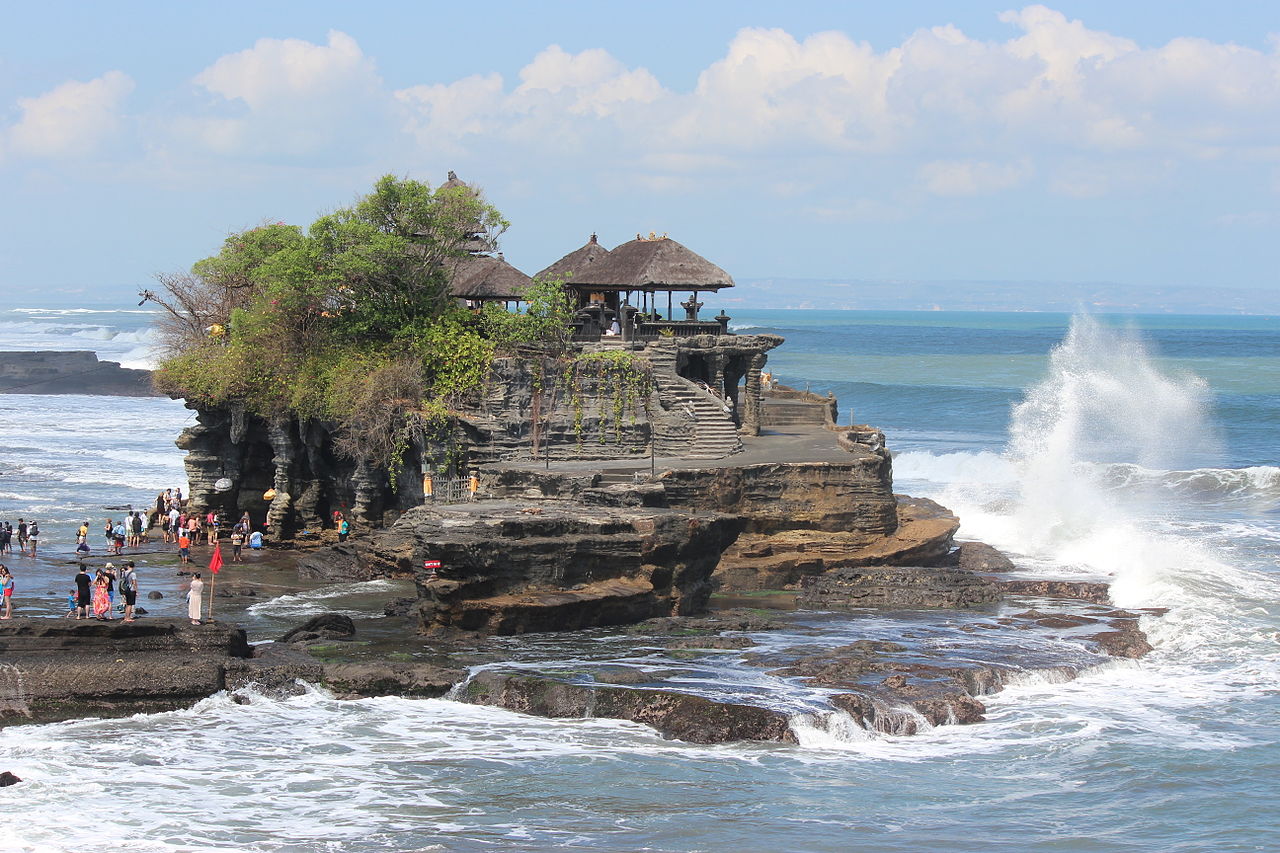
16th-century sea temple on a tide-island offshore rock. Sunset is iconic; high tide cuts the temple off from the mainland.
The famous postcard rice terraces north of Ubud. Photogenic, easy access, very busy by 9 AM. Multiple swings and viewpoints.
Plus 10-30k IDR donations at viewpoints (often pushed)
Active 1,717m volcano. 2-hour pre-dawn climb with a guide; sunrise above the clouds; breakfast cooked in volcanic steam at the summit.
Per person, includes guide, breakfast, and Ubud-area pickup
Twin world-class surf beaches 5 minutes from Uluwatu Temple. Padang has crystal water; Bingin is the warung-and-surfboard beach scene.
Dramatic clifftop island 30 min by speedboat from Sanur. Kelingking T-Rex viewpoint, Angel's Billabong tide pool, Diamond Beach steps, Crystal Bay snorkel.
Full-day organized tour; speedboats only ~350k IDR round-trip if DIY
Worth it once the must-sees are done. Tap a row for the detail.
10th-century water temple where Balinese Hindus perform melukat purification under spring-fed fountains. Visitors can participate in a sarong.
Includes sarong + locker

Bali's largest and holiest temple complex — 23 separate temples on the slopes of active volcano Mount Agung.
Includes mandatory sarong + guide
.jpg/330px-Pura_Lempuyang_Luhur_(49549545657).jpg)
Famous "split-gate with Mt Agung framed" Instagram spot. Real temple is at the top of 1,700 stone steps.
UNESCO-listed terraced landscape covering 600 hectares — bigger, less commercial, far emptier than Tegalalang.

Closest waterfall to Ubud — easy 10-min walk down, big plunge pool, can swim. Crowded after 10 AM.
Often called Bali's most beautiful falls — seven streams drop into a lush jungle canyon. Requires a guided 1-hour hike.
Mandatory guide fee

700 long-tailed macaques in a 12-hectare temple-forest in central Ubud. Walking paths, 14th-century shrines, rope bridges.

Nomad-and-surf strip with grey-sand beach breaks, vegan cafés, and beach clubs. Where most expats live.

Sunset-dinner-on-the-beach territory. Ku De Ta, Potato Head, La Plancha bean-bag bars line a long flat sand stretch.

East-side calm-water beach: walking and cycling promenade, gentle reef, sunrise rather than sunset. Quieter, older crowd.

East-coast diving and snorkeling base. USAT Liberty WW2 wreck dive starts from the beach at Tulamben.
Sprawling beach club with three pools, 9 bars, surf-front day-bed seats. The biggest party scene in Canggu.
Day-bed minimum spend; entry to the Strand area is free
Curved-louver architectural icon, infinity pool over the sand, sunset-DJ tradition. Reserve a daybed before noon.
Day-bed minimum spend
Reclaimed-fishing-boat beach club at Echo Beach — best mid-afternoon to sunset for the slow-boho vibe.
Minimum spend

Three tiny coral islands off Lombok, 90 min by fast boat from Padang Bai. No motorbikes, just bicycles and horse carts. Snorkel turtles in Gili Air, party in Gili Trawangan, honeymoon on Gili Meno.
Round-trip fast boat from Padang Bai
Not worth your time or money.
Paying IDR 120,000 for Nasi goreng at a warung
tourist spots. Locals pay about IDR 35,000.
Off the beaten path — places most visitors never find.
Quiet rice-terrace valley 90 min east of Ubud — same scenery without the crowds, 1/3 the prices.
Long empty beach below Uluwatu cliffs — 200-step descent keeps it nearly empty.
Waterfall inside a cave — sun beam at 10-11 AM creates the famous spotlight effect.
UNESCO-listed terraces 5x bigger than Tegalalang and 90% emptier.
Reef-restoration village in north-west Bali with the best easy snorkeling on the island.
Cool-climate hill village with waterfalls and clove plantations — feels nothing like beach Bali.
Plan your days
Copy a plan or let Tripdox build one around your dates.
Tegalalang rice terraces (before tour buses)
Walk down into the paddies
Breakfast at Sayuri Healing Food, Ubud
Smoothie bowl + jamu
Sacred Monkey Forest
Stash sunglasses and phones
Babi guling lunch at Ibu Oka
Order the special set
Drive to Uluwatu (90 min)
Padang Padang Beach
Quick swim or surf-watching
Pura Luhur Uluwatu
Buy Kecak tickets first
Kecak fire dance with sunset
Seafood dinner on Jimbaran Beach
Settle in Ubud, evening culture
Check in to Ubud villa or boutique stay
Lunch at Hujan Locale or Locavore To Go
Campuhan Ridge Walk (1.5h)
Sunset cocktails at Karsa Kafe
Dinner at Mozaic or Locavore NXT
Cultural full day
Tegalalang rice terraces (early)
Tirta Empul Holy Spring + purification
Sacred Monkey Forest
Lunch at Warung Babi Guling Ibu Oka
Tegenungan Waterfall + swim
Spa massage at Karsa Spa or Putri Bali
Dinner + traditional Legong dance show
Move base, beach + temple
Drive Ubud → Uluwatu (2h)
Check in to Uluwatu villa
Lunch at Single Fin overlooking the surf break
Padang Padang or Bingin Beach
Uluwatu Temple + Kecak dance
Jimbaran Bay seafood dinner
A theme for each day — reorder it around your flights.
Arrival — drive to Ubud, slow start
Ubud temples + Tegalalang + Monkey Forest
Mount Batur sunrise hike
Move to Canggu/Seminyak, beach club + sunset
Nusa Penida day trip from Sanur
Uluwatu — Padang Padang + Kecak dance
Spa morning + Jimbaran sunset dinner + departure
A perfect day
9 stops from 06:00 to 22:00. Follow it end to end, or borrow the parts you like.
Yoga Barn 7 AM class is the Ubud institution; or just walk Campuhan Ridge before anyone else.
Cassava Café (Ubud), Crate Café (Canggu), or Sisterfields (Seminyak). 80-150k IDR.
Temple visit, monkey forest, or rice-terrace walk. 1.5-2 hours.
Nasi campur with sate lilit and lawar at a local warung — 40-70k IDR for a full plate.
Spa at Karsa or Putri Bali (300-600k IDR for 90 min), or beach club afternoon.
Tegenungan Waterfall, Bali Swing, or surf lesson at Batu Bolong.
Tanah Lot, Uluwatu, or beach-club bean bag. La Plancha, La Brisa, or Single Fin all hit hard.
Locavore (tasting menu), Mamasan, Sardine, or seafood-on-the-sand at Jimbaran. 400-1.8M IDR per person.
Old Man's (Canggu), Sky Garden (Kuta), Potato Head (Seminyak). Ubud is dead by 11 PM.
Estimated spend for the dayIDR 1,315,000
Based on the 4 of 9 stops that list a cost.
Food & drink
8 dishes to try and 8 places to eat in Bali, from about IDR 75,000 to IDR 1,800,000 a head.
Bali's signature dish — slow-roasted suckling pig stuffed with turmeric, lemongrass, and coriander. Crispy skin is the prize.

Whole duck rubbed in basa genep spice paste, wrapped in banana leaf, slow-cooked 6+ hours.
Per duck for 2-3 people; usually pre-order

Mixed-rice plate: pork sate lilit, lawar, sambal matah, urap (vegetables), shrimp crackers. The default lunch.

Minced fish-or-pork satay wrapped around lemongrass stalks instead of bamboo skewers.

Mixed vegetable, grated coconut, and meat salad spiced with basa genep. Lawar Putih (white) is mild; Lawar Merah (red) uses pig blood.
.jpg/500px-Nasi_Goreng_Kampung_(11967588375).jpg)
Ubiquitous fried rice / fried noodles topped with a fried egg, sambal, and prawn crackers. Available everywhere from warungs to luxury hotels.
Battered fried banana — every warung's afternoon snack, often served with palm-sugar syrup.

Balinese rice or palm liquor (~30-40% ABV). Order arak madu (with lime and honey) — neat is rough.
Cocktail at a bar; 50k IDR for a bottle at a shop
Our shortlist, cheap to splurge.
Warung Babi Guling Ibu Oka
Traditional Balinese · Central Ubud
Signature: Babi guling plate with crispy skin
Naughty Nuri's
Western/Balinese ribs and martinis · Ubud (original) + Seminyak
Signature: Pork ribs and famous martinis
Bambu Indah
Balinese village kitchen · Sayan, Ubud
Signature: Heritage Balinese sharing menu
Cuca
Modern tapas + cocktails · Jimbaran
Signature: Coconut prawn dumplings
Mamasan
Pan-Asian fine dining · Seminyak
Signature: Crispy duck pancakes
Sardine
Seafood by the rice paddies · Seminyak
Signature: Wood-fired Jimbaran red snapper
Locavore NXT
Modern Indonesian tasting menu · Ubud
Signature: 12-course farm-to-table tasting menu
Sundara at Four Seasons Jimbaran
Beachfront fine dining · Jimbaran Bay
Signature: Sunset menu with Jimbaran seafood
Getting around
Bali has no metro, no commuter rail, and limited public buses. Most travelers use Grab/Gojek apps in cities, scooters for short hops, and private drivers for full-day trips. Distances look short on Google Maps but traffic doubles drive times in Canggu, Kuta, and Ubud.
Short hops within a base (Canggu, Ubud, Uluwatu)
Per day; helmet usually included, fuel extra ~15k IDR
Short rides, airport transfers, food delivery
GrabCar Seminyak airport ~120k IDR; GoJek Bike same trip 35k
Full-day sightseeing trips, multi-stop itineraries
8-10 hours; includes English-speaking driver
Reliable metered alternative when Grab unavailable
Metered; airport flat rate displayed at counter
4 options · fastest 30 min · cheapest IDR 120,000
GrabCar to Seminyak
FastestCheapestPickup point is a 3-min walk from arrivals (signposted)
30 min
IDR 120,000
GrabCar to Canggu
Traffic doubles this 4-7 PM
50 min
IDR 180,000
Pre-paid taxi to Ubud
Counter inside arrivals; Grab same trip ~250k
75 min
IDR 400,000
Hotel transfer to Uluwatu
35 min
IDR 350,000
Realistic travel times between the places you'll actually go.
DPS (Ngurah Rai Airport)Seminyak
DPSUbud
SeminyakUbud
UbudUluwatu
SanurNusa Penida
Padang BaiGili Trawangan
Practical
Etiquette, money, a few words of Indonesian, safety and what to pack.
Do
Avoid
Essentials
Climate
Cultural
Electronics
If something goes wrong
Save these before you land. Tap a number to call from your phone.
Jl. Bypass Ngurah Rai 100X, Kuta
Kawasan ITDC Blok D, Nusa Dua
Jl. Sunset Road No.818, Kuta
Jl. Diponegoro, Denpasar
Jl. Raya Andong, Ubud
FAQ
Straight answers to the 20 questions first-time visitors ask most.
May to September is the dry season — sunny days, low humidity, calm seas, every restaurant and beach club open. June-August is peak (highest prices, biggest crowds, especially Australian school holidays). May and September are the sweet spots: same dry weather, 25-30% lower prices, fewer crowds. Avoid November to March if you hate daily rain — afternoon storms are reliable. December 22 to January 5 sees both wet weather AND Christmas/New Year price surge.
Seven days minimum for a first trip. The standard split is 3-4 nights in Ubud (culture, rice terraces, monkey forest, Mount Batur sunrise hike) + 4-5 nights in Seminyak/Canggu/Uluwatu (beach clubs, surf, sunset temples). Ten days lets you add the Gili Islands or 2 nights in Sidemen / Munduk. Two weeks lets you add Lombok or Nusa Lembongan as a secondary trip.
They're different trips. Ubud is inland, cultural, slow — yoga retreats, jungle villas, rice paddies, no nightlife. Seminyak is beach, fine dining, and beach clubs — sunsets, parties, designer shopping. Almost no first-time visitor picks one over the other; the right answer is "split your stay" — 3-4 nights in Ubud, 3-4 nights in Seminyak or Canggu. If you're forced to choose: pick Ubud for couples and wellness, Seminyak/Canggu for beach + nightlife.
Cheap by Western standards, on par with Thailand and Vietnam. Backpackers spend ~600,000 IDR (~USD 38) per day in hostels. Mid-range travelers spend 2,000,000-2,500,000 IDR (~USD 130-160) per day for 4-star villas, restaurant meals, and a private driver some days. Luxury starts at 7,500,000 IDR (~USD 480) for Four Seasons / Bulgari level. Beach clubs and Seminyak fine dining are noticeably pricier than Ubud or Canggu warung scene.
Most passport holders (US, UK, EU, Australia, Canada, Japan, etc.) get a Visa on Arrival (VOA) for 30 days at Ngurah Rai Airport — costs 500,000 IDR (~USD 35) cash or card. Apply for the e-VOA online beforehand to skip the airport queue. ASEAN passport holders enter visa-free for 30 days. Extensions to 60 days require a visit to immigration (best done via an agent, ~1.5M IDR). Indian passport holders need to apply for an e-VOA in advance. Confirm on the official Indonesian immigration site for your specific passport.
Within a base (Ubud, Canggu, Uluwatu): scooter (75k IDR/day) or Grab Bike (20-50k per ride). Between bases: private driver (750k IDR/full day) or GrabCar (120-300k). To islands: fast boat from Sanur or Padang Bai. Bali has no metro, no commuter rail, and very limited public bus. Distances look short on Google Maps but traffic doubles drive times in Canggu, Kuta, and Ubud — always allow buffer.
Generally yes, for normal tourist common sense. Violent crime against tourists is extremely rare. The real risks are: (1) scooter accidents — wear helmets and avoid riding at night; (2) Bali Belly food poisoning — drink only bottled water, eat at busy warungs; (3) drug laws — Indonesia has the death penalty for trafficking, never accept "gifts" from strangers; (4) rip currents at Kuta, Echo Beach, Padang Padang — only swim where surfers paddle out; (5) ATM skimming — use bank-branch ATMs only.
Bali Belly is traveler's diarrhea — usually from contaminated water, raw vegetables washed in tap water, or ice in drinks. Roughly 30-40% of first-time visitors get hit. Avoid by: drinking only bottled or filtered water (including for brushing teeth), eating at busy warungs (high turnover means fresh food), avoiding salads and ice cubes from non-upscale spots, and washing hands frequently. Carry Imodium and rehydration sachets (oralit). Symptoms beyond 48 hours = see a clinic; BIMC and Siloam are excellent.
No. Tap water is not potable anywhere in Bali, including in 5-star hotels. Even brushing your teeth — use bottled or filtered water. Most hotels provide 2L of bottled water per day; refill stations at cafés and yoga studios are common (bring a reusable bottle to save plastic). Ice in upscale restaurants and beach clubs is made from filtered water and safe; avoid ice at small warungs.
Depends on what you want. For surf: Padang Padang and Uluwatu (advanced), Batu Bolong in Canggu (learners). For sunset and beach clubs: Seminyak, Echo Beach. For calm swimming: Sanur (east coast), Nusa Dua (south). For dramatic scenery: Diamond Beach and Kelingking on Nusa Penida. For diving and snorkeling: Amed (USAT Liberty wreck) and Pemuteran. Skip Kuta Beach unless you specifically want backpacker chaos.
Nyepi is the Balinese Hindu New Year — a 24-hour silent fast that falls in March (date varies; 2026 is March 19). For 24 hours: no flights in or out, no traffic on roads, no lights at night, no entertainment, no leaving your hotel. Foreigners are required to stay inside their accommodation. Hotels run with curtains drawn and minimal staff. Most travelers either avoid Bali around Nyepi or stay at a beach resort with self-contained dining. The Ogoh-Ogoh parades the night before are spectacular.
Roughly the same as Thailand mainland (Chiang Mai, Bangkok), pricier than Vietnam, similar to or slightly more than Goa for mid-range travel. A week in Bali on a mid-range budget runs USD 450-650; same week in Phuket is USD 500-700; Goa is USD 380-500. Bali is cheaper for spas, yoga, and accommodation; pricier for alcohol and beach-club minimums. Local food (warung) is the cheapest in Bali; fine dining is on par with mid-range Bangkok or Mumbai.
South Bali (Seminyak, Canggu, Kuta) has SE Asia's densest beach club scene — Potato Head, Finns, La Brisa, Old Man's, Single Fin, Sky Garden. Beach clubs run from afternoon to ~midnight; nightclubs (LXXY, Mirror) until 3-4 AM. Ubud is dead by 11 PM by design — culture and wellness, not parties. Uluwatu has cliff-edge bars (Single Fin, Sundays Beach Club) that close earlier. Drug laws are strict — don't buy from anyone in clubs.
Yes — Bali is among the safest and easiest destinations for solo women in Asia. Ubud is especially welcoming (yoga and wellness scene attracts a heavy solo-female demographic). Standard precautions apply: avoid walking alone on unlit roads at night, watch your drink at clubs (drink-spiking incidents have occurred at Kuta clubs), and use Grab over street taxis after dark. Solo female ridership on scooters is normal and accepted. Many guesthouses run group dinners and yoga classes that make meeting people easy.
Technically no — Indonesia requires either an Indonesian license or a valid International Driving Permit (IDP) endorsed for motorcycles. Police checkpoints in Canggu, Kuta, and Ubud regularly stop tourists; the on-the-spot fine is 250-500k IDR (often negotiated). More importantly, your travel insurance is void if you crash without an IDP — and the average Bali scooter accident hospital bill is 15-30M IDR. Get the IDP at home before traveling.
Backpackers spend around 4,200,000 IDR (~USD 270) for 7 days — hostels, scooter, warung food, free beach days, one paid activity. Mid-range travelers spend 15,500,000 IDR (~USD 1,000) — 4-star villas, restaurant meals, private driver days, Nusa Penida day trip, surf lessons. Luxury travelers spend 52,500,000+ IDR (~USD 3,400) — Four Seasons / Bulgari, fine dining, private driver, multiple activities, in-villa spa. Add international flights separately (USD 700-1,500 from Europe/US).
Stay in BOTH. The optimal first-time Bali split is 3-4 nights Ubud (culture, jungle villa, rice terraces, monkey forest, Mount Batur hike, spa) followed by 3-4 nights Canggu OR Seminyak (beach, surf, sunset clubs, fine dining). Canggu is younger, surfier, and has the nomad scene; Seminyak is more upscale with established beach clubs and shopping. If you're forced to pick one base only and don't care about beach: Ubud. If beach matters: Canggu (under 35) or Seminyak (over 35).
Visa and Mastercard are accepted at hotels, beach clubs, fine-dining restaurants, and most upscale shops in Seminyak, Canggu, Ubud, and Nusa Dua. Warungs, scooter rentals, beach vendors, spas, and Grab Bike fares are cash-only. Carry 500k-1M IDR per day in small notes (50k and 100k bills). ATMs are everywhere; use bank-branch machines (BCA, Mandiri, BNI) inside lobbies — free-standing ATMs in tourist zones have a skimming history. AmEx is rarely accepted outside 5-star hotels.
Bali has two active volcanoes: Mount Agung (3,031m, last major eruption 2017-19) and Mount Batur (1,717m, last erupted 2000). Both are monitored by the Indonesian volcanology agency (PVMBG). Mount Batur is the popular sunrise-hike volcano; routes are open whenever the alert level is "Normal." Mount Agung's sunrise hike is much harder and reopens only when alerts allow — check before booking. Eruption ash can ground flights from DPS for 1-3 days; travel insurance with volcanic-disruption cover is worth it.
Yes — Nusa Penida is the single best day trip from Bali. The 30-min speedboat from Sanur lands you on a dramatic clifftop island with viewpoints (Kelingking T-Rex, Diamond Beach, Angel's Billabong) that don't exist on mainland Bali. Caveats: roads on Penida are bad, drivers are aggressive, and the famous viewpoints are 1-2 hour drives apart. Either book a private driver (4M IDR/day for the group) or a small-group tour (1.2M IDR per person). Avoid the cheapest mass-tour boats — they cram you into 60-person buses and skip viewpoints.
Your move
Describe your trip in a few sentences. Tripdox finds flights, picks hotels, orders your days and builds the full itinerary — priced in IDR or your own currency.
Free · No credit card · 2 minutes
More guides built the same way — read one, then let Tripdox plan it.


.jpg/1280px-Mandrem_Beach_and_Mandrem_River,_Mandrem,_Goa,_India_(edit).jpg)


_The_Dubai_Fountain_at_Dusk_02.jpg/1280px-(UAE)_The_Dubai_Fountain_at_Dusk_02.jpg)